Questions to Ask Before Hiring a Professional Caregiver (In-Content Caretakers)
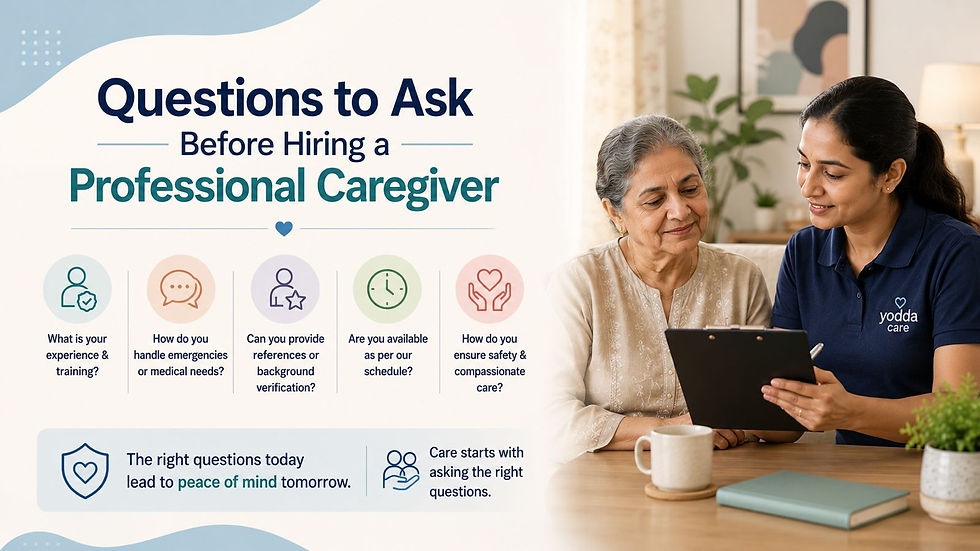
The most important questions to ask when hiring a caregiver fall into five areas: background verification, training and credentials, emergency response, references, and how the caregiver handles your parent's specific medical needs. Ask these before signing anything. A caregiver who answers them clearly and specifically is one worth trusting. Hesitation or vagueness on any of them is your signal to keep looking.
According to the World Health Organization, around 1 in 6 people aged 60 and older experienced some form of abuse in community settings in the past year. Closer to home, a 2024 study in the Indian Journal of Community Medicine found elder abuse prevalence of 44.6% across a surveyed population in Mangaluru.
Those numbers are why the hiring conversation matters so much. When you bring a caregiver into your parent's home, you are handing a near-stranger access to your parent's body, possessions, and trust. The questions to ask when hiring a caregiver are not a formality. They are your primary tool for protecting your parent. Here is what to ask, and why each question matters.
Key Takeaways
Background verification is the first and most important area to question. Ask for documented proof of police verification, not a verbal assurance.
Match the caregiver's specific experience to your parent's specific condition. General caregiving experience is not the same as experience with dementia, stroke recovery, or dialysis.
Emergency response is the most overlooked area. Ask the provider to describe their protocol in clear, sequential steps. Vagueness here is disqualifying.
Consistency of caregiver and transparency of daily reporting are what make long-distance oversight possible.
In India's unregulated elder care sector, your questions are the only quality check in place. Ask thoroughly and accept only specific answers.
Questions About Background and Verification
Start here, because nothing else matters if this part is weak.
Has this caregiver undergone formal police verification and a background check? This is the single most important question for caregivers. Ask to see documentation, not just a verbal assurance. A reputable provider verifies every caregiver before placement and can show you proof.
Can you confirm the caregiver's identity and previous employment? Ask how the provider validates identity documents and confirms past work history. A caregiver's references should be traceable to real previous employers, not just informal character mentions.
Who is liable if something goes wrong? Establish clearly whether the caregiver is employed by an agency that carries responsibility, or whether you are hiring an individual directly with no institutional backing. This distinction matters enormously when a problem arises.
If a provider hesitates on any of these, treat it as a serious warning. Yodda addresses this at the structural level: every caregiver is an ex-Indian Army veteran, selected for discipline and trustworthiness, and every member is supported by protocols certified to ISO 9001:2015 and ISO 22320:2018 standards. You can see how this is structured on Yodda's services page.
Questions About Training and Credentials
A caring attitude is not the same as competence. Both matter.
What formal training does the caregiver have? Ask specifically about first aid, CPR, and any geriatric care certification. Ask whether they have been trained to handle your parents' conditions.
Have they cared for someone with my parents' specific condition before? A caregiver experienced with mobility support is not automatically equipped to care for someone with dementia, post-stroke needs, or dialysis requirements. Match the experience to the need.
What ongoing training does the provider give caregivers? Good providers do not treat training as a one-time event. Ask how skills are kept current.
These questions to ask home health care providers separate genuine professionals from people simply looking for work. The answers tell you whether your parent's caregiver knows what to do when something specific to your parent's health happens.
Questions About Emergency Response
This is the area families most often forget to ask about, and the one that matters most in a crisis.
What exactly happens if my parent has a medical emergency? Ask the provider to walk you through the steps in order. Who does the caregiver call first? How fast does help arrive? Who decides on hospitalization?
Is there 24/7 support behind the caregiver? A single caregiver cannot be awake and present at all hours. Ask what backup is available when the caregiver is off duty, asleep, or dealing with a situation beyond their training.
How will I be informed during an emergency? Especially if you live in another city or abroad, you need to know how and how quickly you will be contacted.
A provider with real emergency capability will describe a clear, sequential protocol. Yodda's 24/7 Emergency Command Center, staffed by trained veterans, sits behind every caregiver precisely so that a single person is never the only line of defense.
Questions About References and Track Record
Can you provide references from current or past clients? Ask to speak with families who have used the provider. A provider confident in their service will arrange this without resistance.
Can you share an example of how you handled a difficult situation? This is one of the most revealing questions you can ask a caregiver. The specifics of how a provider responded when something went wrong tell you more than any brochure.
What is your client retention like? Families who stay with a provider for years are a strong signal. High turnover, on either the client or caregiver side, is worth probing.
Questions About Daily Care and Communication
The day-to-day relationship is where the quality of care actually lives.
Will the same caregiver be assigned consistently? Continuity matters. A rotating cast of unfamiliar faces cannot build the trust and routine your parent needs, nor can they notice subtle changes that signal a developing problem.
How will daily care be documented and shared with me? Ask whether visits are logged, whether you receive updates, and whether there is an app or system giving you visibility. This is one of the questions to ask home health care providers that reveals how modern and accountable their operation is.
How are concerns or complaints handled? Know the escalation path before you need it.
Yodda assigns each member a dedicated Primary Care Representative who provides daily well-being calls and consistent communication with the family.
A Few More Questions Worth Asking Before Hiring a Professional Caregiver
These come up less often but can matter just as much. Run through them before you finalize anything.
What happens if the assigned caregiver falls sick or goes on leave? Who replaces them?
Is there a trial or notice period, and what are the terms for ending the arrangement?
Will the caregiver assist with tasks outside core care, such as cooking, cleaning, or accompanying my parent to appointments?
Are there any additional charges for night duty, festivals, or last-minute requests?
What languages does the caregiver speak fluently?
How does the provider handle a clash of personalities between my parent and the caregiver?
Is the caregiver trained to operate my parent's specific medical equipment, such as a glucometer, nebulizer, or oxygen concentrator?
What is the provider's policy on the caregiver handling my parent's money or making purchases?
Will the caregiver follow a written care plan, and can I see it in advance?
How are medication timings tracked and confirmed each day?
What happens to my parents' care during a natural disaster, a citywide emergency, or a transportation shutdown?
Does the provider carry any insurance that covers incidents during care?
Why These Questions Matter More in India
India's elder care sector is largely unregulated. As the NITI Aayog's 2024 position paper on Senior Care Reforms acknowledges, there is no mandatory national certification or inspection system for in-home care providers. The government does not maintain quality data on private caregivers.
That means no external body is checking the answers for you. The questions to ask when hiring a caregiver are the only quality-control mechanism most families have. The thoroughness of your questions and the specificity of the answers you accept directly determine the safety of your parents' care.
If you would rather start with a provider that has already built verification, training, and emergency response into its structure, you can review Yodda's care plans, which start at ₹9,999 per month, or reach the team directly through the Yodda contact page to discuss your parent's needs.
FAQs
What is the single most important question to ask when hiring a caregiver?
Ask whether the caregiver has undergone formal police verification and a documented background check, and ask to see the proof. A caregiver enters your parent's home and has access to their possessions, medications, and personal space. Verified trustworthiness is the foundation on which everything else rests.
What questions should I ask home health care providers about emergencies?
Ask exactly what happens, step by step, when your parent has a medical emergency: who the caregiver calls first, how fast help arrives, who decides on hospitalization, and how you will be notified. Also, ask what 24/7 backup exists behind the individual caregiver. A clear, sequential answer indicates real capability.
How do I properly check a caregiver's references?
Ask the provider to connect you directly with current or past client families, and speak with them about reliability, communication, and how problems were handled. Also, ask the provider for a specific example of how they managed a difficult situation. The detail in that answer reveals more than any written testimonial.


